What does the COP coefficient mean?

How is the COP coefficient calculated for heat pumps?
The COP value for heat pumps is calculated as the ratio of the heating output produced to the electrical power drawn. For an air-source heat pump, the heating output delivered to the system is the one transferred in the condenser to the heating water. This matters, because MultiTherma pumps additionally use the compressor refrigeration circuit to heat the condensate tray.
IGLOO heat pumps come as standard with a built-in condensate tray made of acid-resistant stainless steel and heated by the hot refrigerant. The power transferred in the tray is „produced for free”, and IGLOO’s declared efficiency also accounts for heating it and the related compressor power draw. So when comparing MultiTherma with a traditional design, you must add the extra power of the tray’s electric heater and the cost of the tray itself, usually made of plastic.
The COP coefficient (Coefficient of Performance) reflects the efficiency of compressor-based heating devices — it is the ratio of heating output to electrical power draw. The higher the COP, the more efficient and cheaper to run the pump is.
The coefficient is calculated for specific reference conditions. Catalogues usually give the COP for the conditions A7W35 — ambient air of 7 °C and heating water of 35/30 °C without glycol. When comparing pumps by COP, check the conditions it was defined for, because it changes with air and water temperature. Alongside COP, efficiency is also described by SCOP and eta s,g.
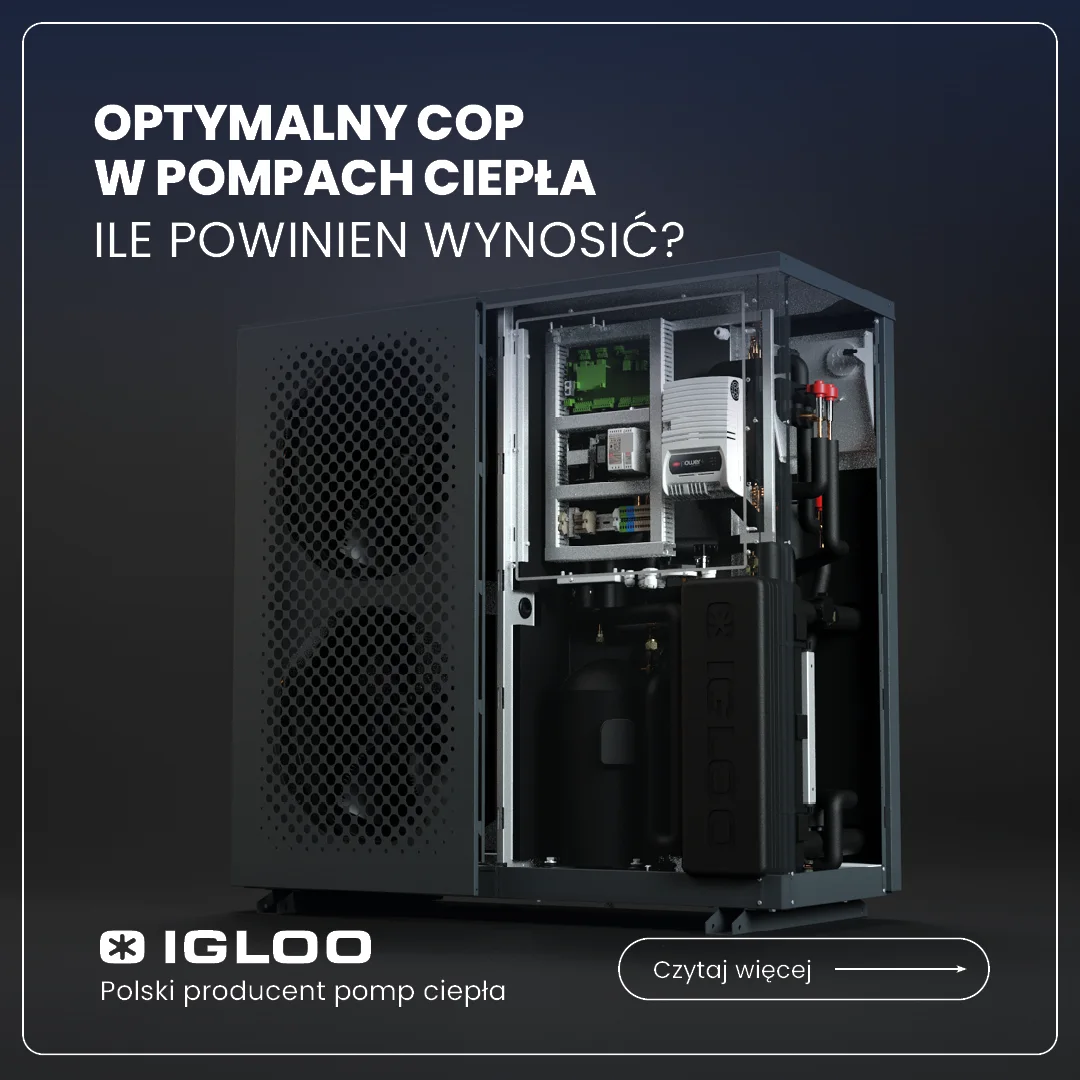
Which COP values are considered optimal?
The higher the COP, especially for the temperatures that occur most often during the season, the lower the running costs. It is worth being guided by the highest possible seasonal index SCOP — after checking for which climate and heating-water temperatures it was declared.
IGLOO heat pumps achieve some of the highest SCOP values even compared with the most efficient designs — even though MultiTherma’s declared efficiency includes heating the condensate tray, which other pumps do not account for. The COP value verified by two independent, accredited laboratories for the model MultiTherma 17 wynosi ok. 5,20, while the averaged seasonal SCOP reaches about 5,0.
What factors affect how COP varies across the seasons?
The key influence — besides the outdoor temperature and how long it lasts — comes from the heating-water setpoint. It is worth setting a weather-compensation curve right after installation and adjusting it during use. A single fixed setpoint lowers efficiency, whether the pump runs at a low parameter (underfloor heating) or a medium one (radiators).
Maximum output is required for less than 1% of the year. If, in the hardest frosts, radiators need e.g. 55 °C at –20 °C, then at 0 °C 40–45 °C is enough, and at +15 °C about 30–35 °C. For underfloor heating similarly: 35 °C at –20 °C, about 30 °C at 0 °C and about 25 °C at +15 °C.
The pump should be sized so that the bivalent point falls at the lowest possible temperature and so that it covers the largest possible share of seasonal demand. In MultiTherma this is possible thanks to the wide range of compressor capacity control — there is no cycling at higher temperatures. Averaged values above have been confirmed across many sites SCOP 6,0 — more real and more relevant to the user than values from laboratory measurements.
← Back to news